
 AVNews24Desk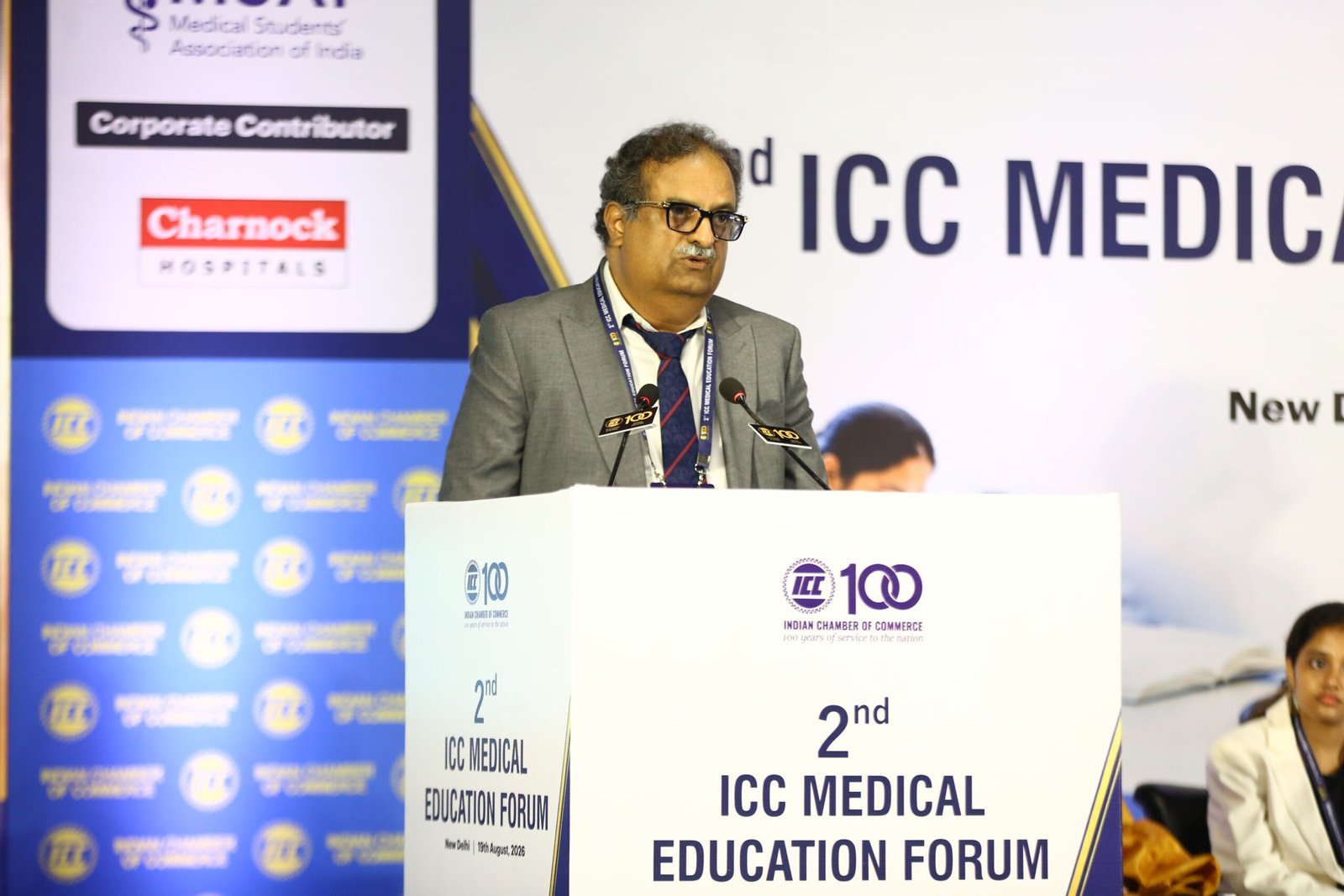
50,000 Doctors Trained in AI, 20 Lakh in CPR: Dr Abhijat Sheth Reveals NBEMS Scale at 2nd ICC Medical Education Forum
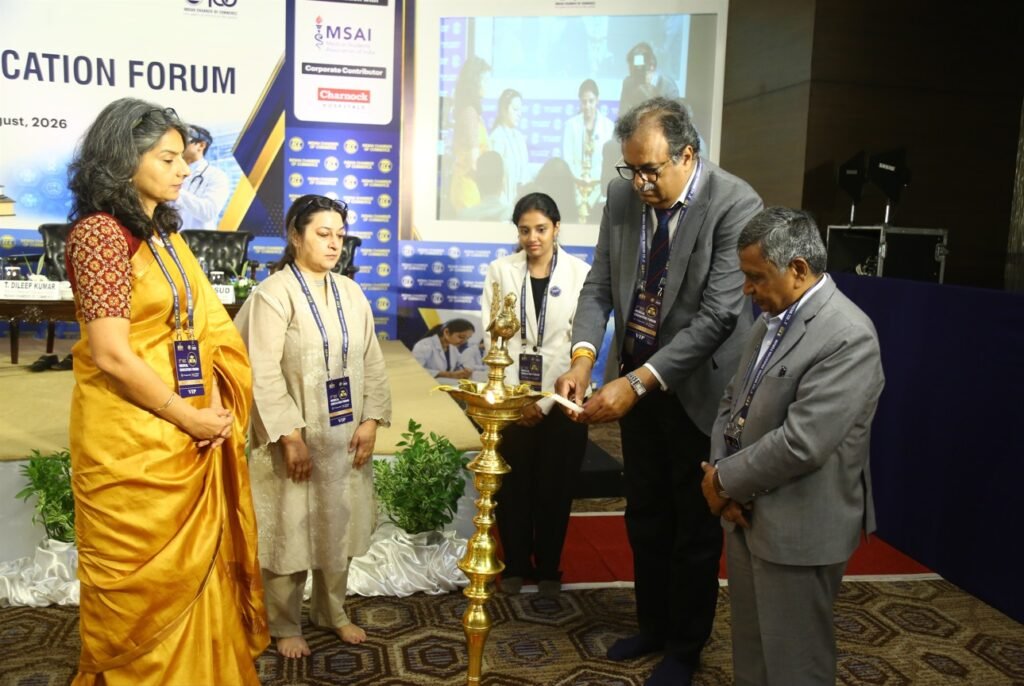
New Delhi: The 2nd ICC Medical Education Forum, organised by the Indian Chamber of Commerce (ICC) in association with the Medical Students Association of India (MSAI), brought together medical education regulators, nursing leaders, academic faculty and student representatives to discuss reforms in clinical training, simulation, competency-based curricula and the use of artificial intelligence (AI) in healthcare education.
Addressing the gathering as Guest of Honour, Dr Abhijat Chandrakant Sheth, Chairperson of the National Medical Commission (NMC), said India now has more than 820 medical colleges and that the priority must shift from simply increasing numbers to improving standards and quality. He said, “The ultimate measure of our success will not be how many doctors we are going to create, but what kind of doctors we are going to create, who will be serving society. We cannot create a two-tier medical education system, where students in some institutions have access to excellent faculty, rich medical material, simulation facilities and research opportunities, while other students receive significantly fewer opportunities.”
On AI, Dr Sheth said, “Modern education must prepare students not merely to use AI, but to understand it as well. AI should never replace professional responsibility and accountability. The doctor must remain accountable for decisions made in the care of patients. That is where technology ends and humanity begins.” Citing NBEMS data, he said nearly 50,000 doctors completed structured online AI training in 2026, while the board’s CPR programme reached approximately 20 lakh healthcare professionals in 2023.
Dr T. Dileep Kumar, President of the Indian Nursing Council (INC), highlighted the Council’s efforts to strengthen simulation-based nursing education, drawing a comparison with pilot training. He said, “The passenger’s safety is in the hands of the pilot. The pilot is generally trained through simulators, and we, the doctors and nurses, are responsible for patient safety.” Citing a National Council of State Boards of Nursing study, he said up to 50% of a BSc Nursing curriculum can be taught through simulation. He also explained that INC, in partnership with Jhpiego, Laerdal Medical India and SGT University, Gurugram, established India’s first National Reference Simulation Centre, followed by a second centre at Sajjalashree Institute of Nursing Sciences, Bagalkot.
Emphasising the importance of trained faculty, Dr Kumar said, “Hardware is very easy to get. By spending the money, you can get the hardware. But software is very important. What is software? Software is the teachers, the faculty, and they need to be trained to integrate simulation as a method of teaching. It is a big challenge.” He said INC has trained nearly 2,000 nursing faculty through structured simulation programmes, signed an MoU with the Digital Health Academy for a six-month AI nursing course and expanded the Nurse Practitioner Critical Care programme to around 66 institutions. He added that India has been elected for the first time to the board of the International Council of Nurses and has submitted a shortlisted bid to host the ICN Congress in 2029.
Dr Richa S Debgupta, Co-Chair of the ICC National Healthcare Committee and Executive Vice President at Fortis Hospitals, said the forum’s theme, “Excellence in Medical Education, Beams with Quality,” reflected the current needs of the healthcare sector. She said, “While medicine evolves, one thing must remain constant, the quality of the healthcare professional we prepare. Medical education must therefore go beyond knowledge. It must build competence, judgment, compassion, curiosity, and character.”
Dr Chaitra B.A., President of the Medical Students Association of India (MSAI), brought the student perspective to the forum and spoke about the exhaustion experienced during internship postings. Referring to MSAI’s policy paper on human resources for health, she said, “A larger workforce doesn’t necessarily mean a stronger workforce. We have to ask where these professionals are going, what conditions they are working in, whether they are adequately trained, whether they can afford to stay in the system.”
On AI, Dr Chaitra said, “The question is not whether AI belongs in medicine, it already does. The question is whether our medical education is preparing students to use it responsibly.” She called for greater student participation in curriculum design and assessment, adding, “Exhaustion is not a competency, and burnout should definitely not be a workforce strategy.”
Dr Ritika Sud, Professor of Medicine at Lady Hardinge Medical College, explained the shift to Competency-Based Medical Education (CBME), introduced nationally in 2019. Describing the earlier system, she said, “It was a very subject-oriented, teacher-oriented curriculum where there was more emphasis on rote learning, memorising facts over application. There was no structured early clinical exposure.”
She said CBME introduced more than 2,600 defined competencies across the MBBS curriculum, along with the Demonstrate-Observe-Assist-Perform (DOAP) method and the Attitude, Ethics and Communication (AETCOM) module. These are taught through role play and standardised patient encounters and assessed on an ongoing basis. She added that India now has approximately 706 medical institutes offering around one lakh MBBS seats annually, while faculty readiness and examination culture remain continuing implementation challenges.
The forum highlighted a clear shift in priorities for Indian medical education. The challenge is no longer simply about increasing the number of medical colleges, seats or simulation centres. The greater challenge lies in preparing faculty, strengthening curriculum design and equipping students for an increasingly AI-integrated healthcare system. This emerged as a common point of agreement among the speakers at the forum.




Нарколог оценивает не только сам факт употребления, но и выраженность нарушений. Некоторые признаки указывают, что лечение на дому может оказаться недостаточным. Врач обращает внимание на уровень сознания, пульс, артериальное давление, дыхание, степень обезвоживания, поведение и наличие сопутствующей патологии. При следующих симптомах важно не откладывать медицинскую помощь.
Получить больше информации – вывод из запоя на дому москва недорого
pinco visa pinco visa
Рекомендации строятся вокруг состояния человека, а не по универсальному шаблону для всех случаев.
Ознакомиться с деталями – http://4.vyvod-iz-zapoya-moskva011.ru/
Marge has a threesome with carl and lenny the simpsons hentai pornhub
https://fingering-hormone.sexyico.com/?yasmin-kallie
purtorican porn devon porn videos japanese porn download avi internet records porn sites local slave porn pics
mostbet вывод на банковскую карту Кыргызстан https://mostbet67256.shop/
Nude model ha young eun bares all with her first book
https://adultbluevideo-funnyadultvideos.adablog69.com/?alize-tania
young virgin daughter porn great ass to mouth porn vids irish porn site aunt peg porn movies pov porn for iphone
Jump in and browse our full range of casino games https://casino-ohneoasis.site/bonus.html
https://tango-wiki.win/index.php/Pack_de_bienvenue_machines_%C3%A0_sous_:_comprendre_les_bonus_et_offres_pour_nouveaux_joueurs
Здорова, народ Брат снова сорвался Дети напуганы Нужна срочная помощь на дому Короче, единственное что вытащило из запоя — прокапаться от алкоголя на дому быстро Через пару часов человек пришёл в себя В общем, жмите чтобы сохранить — лечение алкоголизма на дому казань https://kapelnica-ot-zapoya-kazan.ru Не ждите пока станет хуже Перешлите тем кто в такой же ситуации
пинко login киргизия https://pinco28253.shop
Щёлково, всем привет Брат снова сорвался Родственники не знают что делать Таблетки не помогают Короче, только это реально спасло — вывод из запоя на дому щелково с выездом Приехали через 40 минут В общем, жмите чтобы сохранить — вывод из запоя на дому вывод из запоя на дому Не ждите пока станет хуже Перешлите тем кто в такой же ситуации
mostbet pul yatırma üsulları http://mostbet13325.shop/
1win ios http://1win01610.help
Помощь можно получить анонимно, с аккуратным оформлением и внимательным отношением к личным данным.
Изучить вопрос подробнее – запой наркологическая клиника
пинко казино бонус https://pinco28253.shop
Кокаин наркотики купить Кокаин, мефедрон, гашиш, бошки купить онлайн Сайт купить марихуану
Здорова, народ Муж просто потерял себя Родственники не знают что делать В больницу тащить страшно Короче, только это реально спасло — вывод из запоя щёлково анонимно Приехали через 40 минут В общем, вся инфа по ссылке — вывести из запоя скорая https://anonimnyj.vyvod-iz-zapoya-na-domu-moskva-snp.ru Не ждите пока станет хуже Перешлите тем кто в такой же ситуации
mostbet приложение скачать Кыргызстан http://www.mostbet67256.shop
Слушайте кто знает Ситуация критическая Дети напуганы Таблетки не помогают Короче, врачи приехали и поставили систему — капельница от запоя цена доступная Поставили капельницу с детоксикационным раствором В общем, жмите чтобы сохранить — прокапать от запоя https://narkolog.kapelnica-ot-zapoya-kazan.ru Не ждите пока станет хуже Перешлите тем кто в такой же ситуации
mostbet поддержка Кыргызстан mostbet поддержка Кыргызстан