
 AVNews24Desk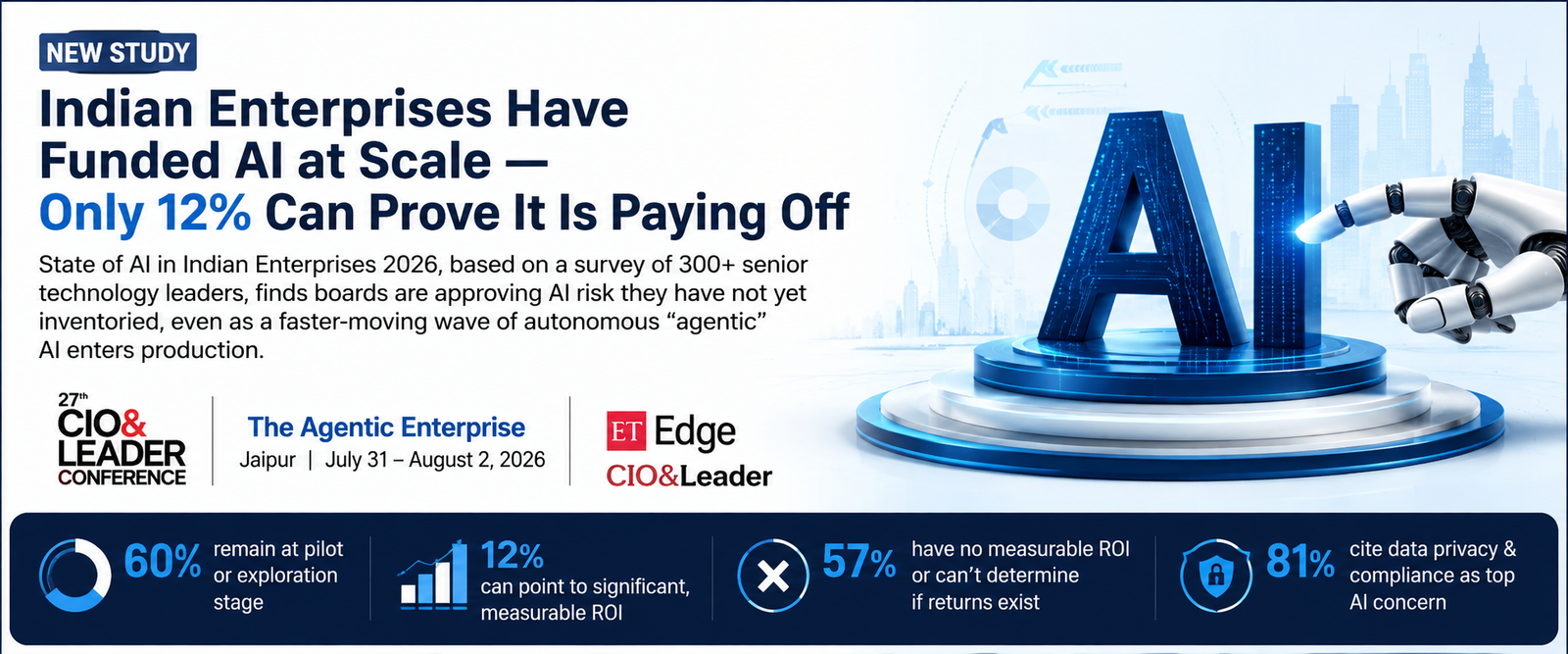
State of AI in Indian Enterprises 2026 is based on a survey of over 300 senior technology leaders. It highlights that while Indian enterprises are accelerating adoption, most organizations are yet to realize measurable business outcomes.
The study also warns that boards are increasingly approving technology-related risks without adequate governance. Even as autonomous, agentic systems begin entering enterprise operations.
Mumbai: Despite investments in artificial intelligence (AI) over the past two years, most Indian enterprises struggle.
Nevertheless, they find it hard to demonstrate tangible business value from these initiatives. This is one of the key findings of the State of Artificial Intelligence in Indian Enterprises 2026. ET Edge CIO&Leader released the report. The insights were unveiled during the 27th CIO&Leader Conference – The Agentic Enterprise, in Jaipur. Dates ran July 31 to August 2, 2026.
The report is based on responses from more than 300 senior enterprise technology leaders surveyed in May and June 2026. It shows many organizations remain in pilot or exploration stages of their AI journey after two years of investment.
More importantly, only 12% of organizations reported significant and measurable returns on investments. Fifty-seven percent admitted they could not measure ROI or had no measurable outcomes. According to the report, this reflects a measurement gap rather than a technology failure.
The findings show a gap between AI ambitions and financial commitment.
Additionally, 83% of technology leaders identified productivity improvement as the primary objective for investing in this area.
Additionally, 55% experienced budget overruns in this area or do not track expenditure separately, making boards hard to evaluate investment effectiveness.
The report highlights governance and regulatory readiness as key concerns. While 81% cited data privacy and compliance as their biggest AI concern, only 19% feel prepared for India’s DPDP act. The scope includes governance and regulatory readiness across privacy, security, and risk controls.
Furthermore, 9% of organizations do not have any formal governance framework for artificial intelligence. Nearly two in five organizations report confirmed or suspected intelligence-related security incidents. These findings underline the urgent need for structured oversight and consistent controls. Without action, gaps in governance could heighten risk across sectors.
At the same time, the report highlights the rapid rise of agentic AI. Agentic systems refer to autonomous systems that execute multi-step tasks and make decisions without constant human intervention. This shift reflects growing confidence in autonomous systems across industries and functions.
Around 64% of organizations are piloting or deploying agentic systems. Forty-six percent of respondents believe it will have the greatest impact on enterprise operations over the next 18 months. These results underline the momentum behind agentic systems and their potential to reshape workflows and decision processes.
Commenting on the findings, R. Giridhar, Editorial Director – Technology, ET Edge, noted that organizations embrace investments in AI. Measurable returns remain limited due to weak governance around pilot selection, business ownership, and performance measurement. These governance gaps hamper timely assessment and scalable deployment.
Jatinder Singh, Chief Editor, Enterprise Tech Publications, ET Edge, added that board approvals for investments signal governance and risk decisions on data privacy and vendor concentration. This framing places oversight expectations on executives and reduces ambiguity around accountability for future projects.
It also underscores oversight of autonomous systems and related risk factors, aligning governance with the strategic use of emerging technologies across units. Executives should document decisions, monitor performance, and adjust policies as pilots scale to ensure accountability and continuous improvement.
The report outlines four priorities for corporate boards over the next 18 months. First, ensure clear business ownership and data readiness before approving AI pilots.
Next, establish measurable ROI benchmarks before expanding investments. Third, treat DPDP compliance as an immediate legal requirement. Finally, implement documented governance frameworks that include autonomy limits, audit trails, and escalation mechanisms. Do not scale autonomous systems beyond pilot deployments until these controls are in place.